


As energy independence becomes a mainstream goal for homeowners, farmers, and remote communities alike, the off grid solar inverter has emerged as the cornerstone of every self-sufficient power system. This guide examines the technology from the ground up — covering operating principles, MPPT efficiency, battery compatibility, safety architecture, and the practical criteria you need to select the right inverter for your application.
1. What Is an Off Grid Solar Inverter?
A standard solar panel produces direct current (DC). Every household appliance — from a refrigerator to a medical device — runs on alternating current (AC). An off grid solar inverter bridges this gap by converting stored DC energy (drawn from a battery bank charged by solar panels) into clean, usable AC power, entirely without a utility grid connection.
Unlike a simple grid-tied inverter, an off-grid unit must also manage battery charging, regulate input from the photovoltaic (PV) array, and maintain stable output voltage and frequency on its own. It is, in effect, a miniature power station.
2. How an Off Grid Solar Inverter Works
2.1 The DC-to-AC Conversion Stage
Inside the inverter, transistors switch the DC input on and off at high frequency, shaping a sinusoidal waveform. High-quality units produce a pure sine wave — mathematically identical to grid power — which is essential for sensitive loads such as variable-speed motors, medical equipment, and modern power supplies.
2.2 Integrated MPPT Solar Charge Controller
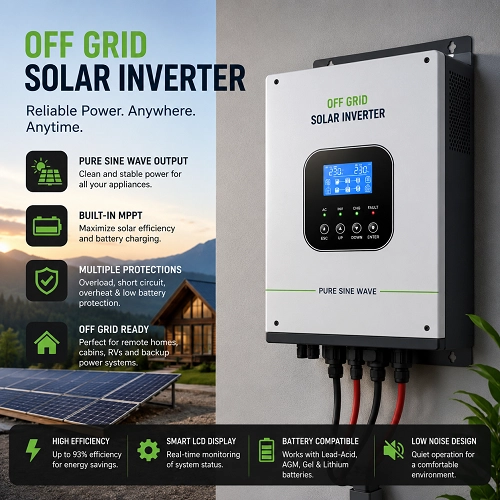
Most modern off-grid inverters embed a Maximum Power Point Tracking (MPPT) controller that continuously finds the optimal operating point on the PV panel's current-voltage curve. Sunohoo Technology's off-grid inverters integrate an MPPT controller with efficiency up to 99.9%, extracting maximum energy even under partial cloud cover.
2.3 Output Modes
A well-designed off-grid inverter offers multiple output modes to handle different scenarios:
Inverter Output Mode — runs entirely from solar + battery, zero grid dependence.
Mains Bypass Mode — passes grid or generator AC directly to the load when available, conserving battery charge.
PV Priority Mode — maximises solar self-consumption before drawing from grid or generator.
Hybrid Charging — combines PV and AC charging for the fastest battery top-up.
3. Core Technical Specifications Explained
| Parameter | Typical Range | Why It Matters |
|---|---|---|
| Rated Output Power | 1 kW – 20 kW+ | Must exceed peak load demand |
| DC Input Voltage | 24 V / 48 V / 96 V–600 V (HV) | Determines battery bank configuration |
| AC Output Waveform | Pure sine wave | Required for motors and sensitive electronics |
| MPPT Efficiency | 95 % – 99.9 % | Directly affects daily energy yield |
| Conversion Efficiency | 90 % – 97 % | Reduces heat loss and operating cost |
| Transfer / Switch Time | ≤ 10 ms (UPS grade) | Prevents load interruption during mode change |
| IP Protection Rating | IP20 (indoor) – IP66 (outdoor) | Determines installation environment suitability |
| Communication Interfaces | RS485, Wi-Fi, 4G, GPRS | Enables remote monitoring and control |
4. Battery Compatibility
The inverter's battery management subsystem is as important as its power stage. Sunohoo's off-grid solar inverters are compatible with the three most common battery chemistries:
| Battery Type | Typical Voltage | Cycle Life | Best For |
|---|---|---|---|
| Flooded Lead-Acid | 12 V / 24 V / 48 V | 300–500 cycles | Budget installations with maintenance access |
| Sealed AGM / Gel | 12 V / 24 V / 48 V | 400–700 cycles | Indoor or valve-regulated setups |
| Lithium (LiFePO₄) | 48 V – 600 V+ | 3,000–6,000+ cycles | Long-term, high-cycle residential/commercial use |
Lithium iron phosphate (LiFePO₄) batteries have become the dominant choice for new installations. Their high energy density, flat discharge curve, and long cycle life pair exceptionally well with high-voltage inverters in the Sunohoo HS1033EH24L–1055EH48P series, which is designed for PV high-voltage inputs.
5. Safety Protection Architecture
A robust off-grid inverter should protect both the equipment and the installer. Sunohoo's platform incorporates layered protection across six threat categories:
| Protection Feature | Threat Addressed |
|---|---|
| Short-Circuit Protection | Instantaneous overcurrent at output terminals |
| Under-Voltage / Over-Voltage | Battery damage from excessive discharge or charge |
| Overload Protection | Sustained loads exceeding rated capacity |
| Anti-Reflux (Dual) | Reverse power flow into the grid or generator |
| PV Anti-Reverse Connection | Incorrect panel polarity wiring |
| Over-Temperature | Thermal runaway in power electronics |
6. Monitoring & Connectivity
Modern inverters are smart devices. Optional Wi-Fi, RS485, or 4G modules let users track real-time power flows, battery state-of-charge, and fault codes from a smartphone or SCADA dashboard. Sunohoo's energy storage systems also feature a 4.3-inch, 65,000-colour HD touch screen for on-site configuration, supporting multilingual interfaces and time-of-use scheduling for households on variable tariff plans.
7. Typical Application Scenarios
| Scenario | System Size | Key Requirement |
|---|---|---|
| Remote residential home | 3 kW – 10 kW | Pure sine wave, lithium-ready, Wi-Fi monitoring |
| Agricultural irrigation | 5 kW – 20 kW | Motor-start surge capacity, impact load handling |
| Telecom tower / relay station | 2 kW – 8 kW | IP66, UPS ≤10 ms, RS485 remote monitoring |
| Urban backup power | 3 kW – 6 kW | Fast grid-to-battery switchover, compact form factor |
| Industrial / mining site | 10 kW – 50 kW+ | Three-phase output, parallel stacking, high-voltage DC |
For industrial applications requiring three-phase power, Sunohoo's three-phase off-grid solar inverters convert DC power into balanced 380 V / 220 V phase outputs, supporting heavy machinery, water pumps, and community microgrids in remote areas.
8. Maintenance Best Practices
Regular servicing extends inverter life and maintains peak efficiency. A quarterly checklist should include:
Clean housing and vents with dry cloth or compressed air to prevent heat buildup.
Inspect all wiring terminals for tightness, oxidation, or corrosion.
Check the heat sink and clean with a soft brush.
Verify battery voltage is within the normal operating window; avoid deep discharge.
Review monitoring logs for efficiency drops or recurring fault codes.
Confirm at least 10 cm of clear airspace surrounds the inverter on all ventilation sides.
9. Choosing the Right Off Grid Solar Inverter
Selecting the correct unit requires matching the inverter to three interdependent variables: load profile, battery bank, and PV array size. Use this decision framework:
| Decision Factor | Guidance |
|---|---|
| Total load (watts) | Sum all appliances; add 20–30 % margin for surge loads |
| Battery voltage | Match inverter DC input to bank voltage (24 V / 48 V / HV) |
| PV array size | Ensure MPPT input range covers your panel's Voc × string count |
| Output waveform | Always choose pure sine wave for mixed or sensitive loads |
| Scalability | Select models supporting parallel stacking if you plan future expansion |
| Environment | Outdoor installation requires IP65 or IP66; indoor can use IP20/IP21 |


